Yoga philosophy can feel confusing once you move beyond asana and encounter words such as Prakriti and Purusha. Yet the ideas behind them are surprisingly close to everyday experience. Your thoughts change. Your mood changes. Your body changes. Even the way you see a situation can shift from one day to the next.
Still, there is an awareness that notices those changes. Classical Yoga uses Prakriti and Purusha to explain this difference. Prakriti is the changing field of experience, while Purusha is the consciousness that observes it.
Understanding that distinction can help you look at your thoughts, emotions, and habits without letting every passing experience define you.
Think about Prakriti as Everything That Changes
Prakriti can be translated as nature, material reality, or primordial matter. In classical yoga, it includes the body, senses, energy, mind, emotions, thoughts, memories, and the external world.
It includes more than physical nature. Your moods, habits, desires, and mental restlessness are all Prakriti too. And so is the thinking mind.
And it is important because a powerful thought may feel like your identity for as long as you experience it. Yoga philosophy, however, sees it differently. According to this philosophy, a thought is a movement in Prakriti.
The Three Gunas Tell Why Your Inner State Keeps Changing
Prakriti is described by the three qualities known as gunas. They combine in various proportions depending on the circumstances.
- Sattva is the quality that corresponds to clarity, harmony, lightness, and balance.
- Rajas is connected with movement, ambition, stimulation, and restlessness.
- Finally, Tamas represents heaviness, fatigue, resistance, confusion, dullness.
Purusha Is Your Awareness of Experience
Purusha is pure consciousness of witnessing. It does not change. It is not your thoughts, emotions, sensations, personality, social roles and positions.
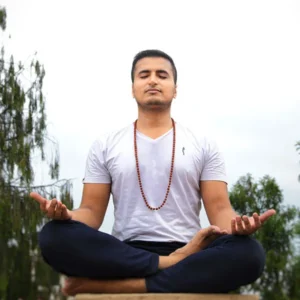
Think of what happens during meditation practice. Some concern may appear, then you may feel tension in the body, and a memory may emerge. All of these phenomena are changing. But at the same time, there is an awareness of all these processes.
Classical Yoga and Samkhya describe it as Purusha.
Realising the Difference Helps to Be More Objective towards Your Thoughts
It may seem tempting to identify yourself with your emotions. Instead of recognising a feeling of anxiety, for example, you start to define yourself through it.
According to the principles of yoga philosophy, there is another way. You can recognise the anxiety that you feel or the emergence of anger without rejecting it. This creates a space between the observer and the experience.
Mind, chitta, is also part of Prakriti. Its movements, vrittis, are thoughts, imagination, memories, sleep, and misunderstanding.
Use Prakriti and Purusha in Your Yoga Practice
To understand these concepts better, you need practice. During asanas, you may be observing strength, discomfort, or even desire to compare yourself with others. During pranayama, you may notice the changes in your energy. Meditation lets you observe the arising and fading of thoughts.
What you should not do is push these experiences away. Instead, you learn to deal with them with awareness and develop discernment.
Apply the Understanding of These Concepts to Your Daily Life
The usefulness of Prakriti and Purusha becomes obvious in daily situations. You may be irritated after some conversation, restless while working, tired in the evening or trapped by self-critical thoughts. Instead of immediately responding, you may notice what is happening.
Your feeling is important, but you don’t have to make a temporary state into your whole identity. This small difference gives you the opportunity to react in a more balanced way. With the practice of yoga, you can start to notice recurring habits.
If you want to explore these concepts and put them into practice, India Yoga School offers the tradition of classical Hatha Yoga, including asanas, pranayama, meditation, mantras, self-study, and yoga philosophy.