Keeping your attention in one place can feel surprisingly difficult. You sit down to focus, but your mind jumps to tomorrow’s plans, an old conversation, a sound outside, or something you forgot to do. But classical yoga knew this problem long before notifications invaded people’s lives nowadays. Dharana is the process of training your attention to stay focused on one single object. It can be anything. Your breath, a mantra, a candle flame, or any sound.
The Role of Dharana in the Eight Limbs of Yoga
Dharana is the sixth step in the eight-limb pathway in yoga that was described by Patanjali. It goes after Yama, Niyama, Asana, Pranayama, and Pratyahara. After Dharana there are Dhyana and Samadhi.
However, there are no strict staircases between the limbs of yoga, they interrelate with each other. Your posture can decrease your physical unrest and conscious breathing can settle the mental agitation. That is why practices such as Hatha Yoga and pranayama can create better conditions for concentration.
Dharana Requires Returning Attention, Not Perfect Mental Silence
The common misunderstanding of Dharana is that it implies absence of thoughts.
They still can appear, it is just necessary to realise when you become distracted and direct your attention to the chosen point.
Your object of focus may be your natural breathing, silent repetition of mantra, candle flame, or sacred image. Or you may choose to focus on your chant, any sound, or internal sensations in your body. Every return will train you in staying attentive.
Dharana and Dhyana Are Related to Each Other but Have Different Meaning
In Dharana the person makes efforts to concentrate on the chosen object.
But in Dhyana (meditation) there are fewer interruptions and breaks because of the more stable attention. It means that Dharana is like the process of protecting the lamp flame from various obstacles and Dhyana happens when the flame burns steadily and consciousness flows easily.
That is why Dharana is an important step to meditation.
Practice Dharana with Several Minutes a Day
There is no need to invent some complex practice.
On the contrary, short daily practice can bring more benefit than infrequent sessions of longer duration.
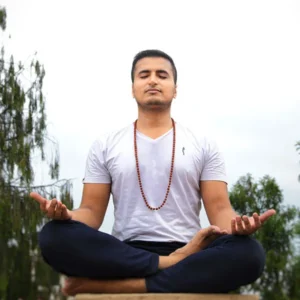
Sit down comfortably on the floor or on a chair in an erect position. Relax your shoulders, face, and hands. Then take several deep breaths and select one focus (breath or mantra).
When you become distracted, notice it without judging. Then bring your attention back. It is possible to begin with 5-10 minutes and then increase the practice time. Patience and regularity are more important than efforts to concentrate.
Practise Dharana During Regular Activities
Dharana is not limited only by your sessions of meditation. You can perform this practice while doing yoga postures, reading, walking in nature, talking to someone, or performing daily activities.
If your mind wanders quite often, do not take it as a sign of your poor performance in meditation. This is a natural process and the very act of noticing the distraction and returning is a part of practice. Dharana can help you to develop the skills of keeping your attention steady with patience and understanding of the meaning of concentration in yoga.
If you want to discover more about this practice beyond just a few minutes at home, India Yoga School is the place where the practice of Hatha Yoga, pranayama, meditation, philosophy, and many other yogic practices converge